


 Cofre, madeira e madrepérola. Índia, Gujarat, possivelmente finais do séc. XVI
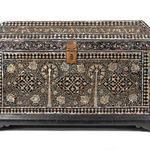
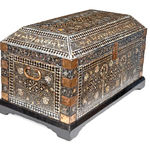
An Indo-Portuguese large mother-of-pearl and mastic Gujarati chest, India, Gujarat; second half of the 16th century
Further images
-
(View a larger image of thumbnail 1
)
-
(View a larger image of thumbnail 2
)

-
(View a larger image of thumbnail 3
)

-
(View a larger image of thumbnail 4
)

-
(View a larger image of thumbnail 5
)

-
(View a larger image of thumbnail 6
)

-
(View a larger image of thumbnail 7
)

-
(View a larger image of thumbnail 8
)
-
(View a larger image of thumbnail 9
)
-
(View a larger image of thumbnail 10
)
-
(View a larger image of thumbnail 11
)

-
(View a larger image of thumbnail 12
)

Exceptional Gujarati teakwood chest (Tectona grandis) of parallelepiped shaped case and truncated pyramidal cover, coated in black mastic and inlaid with mother-of-pearl elements, belonging to a group of utilitarian objects and small to medium sized furniture of mother-of-pearl decoration, made in Gujarat for the local market and for exporting[1]. Of uncharacteristically large size within the scope of this extensive production, it does nonetheless fit into a subgroup defined by objects of identical decorative characteristics[2].
Its ancient design, as is often the case with other contemporary Gujarat productions, namely those made in turtle shell, corresponds to an Indian subcontinent typology characteristic of Islamic contexts predating the arrival of the Portuguese, and purposely conceived for storing, and safekeeping, Buddhist sacred texts, the sutras[3]. The mother-of-pearl raw material for such objects was obtained from marine gastropod (Turbo marmoratus), and pearl oyster (Pinctada maxima) shells, the latter of whiter colour gradation than the former.
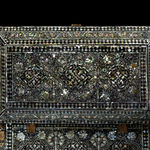
The lavish and intricate carpet like decoration reflects the long-lasting influence of the international Timurid style, as is evident on the cover decorative composition of three central lobate medallions alternating with large, mirrored palm trees on a ground of foliage scrolls, Chinese inspired and stylised lotus flowers and six petalled rosettes. These palms can be identified as Corypha umbraculifera, or talipot palm, a species native to Eastern and Southern India and Sri Lanka, whose leaves were traditionally used as support for writing. The sloping cover surfaces are decorated with framed floral scroll motifs, that are repeated on the upper edges of the box elevations, and scalloped leaf friezes.
The frontal and rear decoration follows a type of arrangement identical to the cover, featuring three lobate medallions with arabesque decorative motifs alternating with fan shaped palms, most certainly Borassus flabellifer, the Palmyra palm, a southern Asia autochthonous species. The lateral panels feature identical decoration but of one single medallion on a ground of foliage scrolls and lotus flowers.
The present chest is closely similar to the well-known example (40.0 x 55.0 x 32.0 cm) at the Descalzas Reales Monastery collection, in Madrid (inv. 00612591)[4], although the latter does not feature decorative medallions, it does however include identical Palmyra palms and Chinese inspired lotus flower motifs. It would have probably entered this Royal Monastery of Barefoot Clarisses, as a gift from Empress Maria of Austria (1528-1603) destined to protect the Martyr Saint Margaret of Antioch’s relics, which had been donated by the religious house’s founder, Joana of Austria (1535-1573), Princess of Portugal, and sister to King Filipe II of Spain. Together with another two mother-of-pearl and turtle shell Gujarati chests, this latter example was part of the “Relics Cabinet” (Relicario), formerly the Princess’s private oratory.
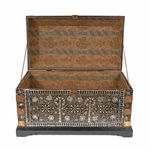
The chest has belonged to the famous Jim Dixon (1942-2020) collection. Dixon was a landscape architect known for his rugs, and other historic textiles, collection. His vast botanical knowledge and his passion for artistic depictions of the natural world, might have encouraged the purchasing of this object that has, probably in the 19th or early 20th century, undergone some alterations to its appearance. In addition to the loss of the pigeon-holes that it originally had in its interior, it was also supplemented with carved wooden mouldings to the cover rim and raised socle, alongside brass corner fittings and lock plate, elements that have been recently removed to return the chest to its original appearance. The inner surfaces have also been restituted to their painted decoration, and the minor losses to the mother-of-pearl inlays refilled, according to traditional techniques and materials. The wooden socle, as well as the cast gilt copper mounts fitted to the original positions, are now compatible with those from other chests of identical production and chronology, in public and private collections.
Hugo Miguel Crespo
Centre for History, University of Lisbon
[1] Hugo Miguel Crespo, India in Portugal. A Time of Artistic Confluence (cat.), Porto, Bluebook, 2021, pp. 28-42.
[2] On this group, see Simon Digby, “The mother-of-pearl overlaid furniture of Gujarat: the holdings of the Victoria and Albert Museum”, in Robert Skelton et al (eds.), Facets of Indian Art, London, Victoria and Albert Museum, 1986, pp. 213-222.
[3] Hugo Miguel Crespo, India in Portugal. A Time of Artistic Confluence (cat.), Porto, Bluebook, 2021, p. 15.
[4] Ana García Sanz, Annemarie Jordan Gschwend, “Via Orientalis: Objetos del Lejano Oriente en el Monasterio de las Descalzas Reales”, Reales Sitios 138 (1998), pp. 25-39, and pp. 29 and 31; and Ana García Sanz, “Relicarios de Oriente”, in Marina Alfonso Mola, Carlos Martínez Shaw (eds.), Oriente en Palacio. Tesoros Asiáticos en las Colecciones Reales Españolas (cat.), Madrid, Palacio Real de Madrid - Patrimonio Nacional, 2003, pp. 128-141, and pp. 130 and 135, cat. VII.1.
Join our mailing list
* denotes required fields
We will process the personal data you have supplied to communicate with you in accordance with our Privacy Policy. You can unsubscribe or change your preferences at any time by clicking the link in our emails.