


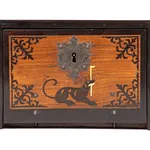
A Dominican Indo-Portuguese Cochin writing cabinet, India, Cochin; 1550–1650
teak, ebony, rosewood, and iron; tinned iron fittings
15.8 × 23.3 × 18.0 cm
F1459
Further images
-
(View a larger image of thumbnail 1
)

-
(View a larger image of thumbnail 2
)

-
(View a larger image of thumbnail 3
)
-
(View a larger image of thumbnail 4
)

-
(View a larger image of thumbnail 5
)

-
(View a larger image of thumbnail 6
)

-
(View a larger image of thumbnail 7
)

-
(View a larger image of thumbnail 8
)

This small fall-front writing cabinet or jewellery box was made inPortuguese-ruled Cochin (Kochi) in Kerala between the mid-sixteenthcentury and the mid-seventeenth-century.Made in teak (Tectona grandis), this writing cabinet is veneeredin ebony (Diospyros ebenum) and decorated with ebonisedEast Indian rosewood (Dalbergia latifolia) and ivory inlays. It bearsthe coat of arms of the Dominican Order on top, and on the exteriorside of the fall-front a dog holds a torch in its teeth, also part of theorder’s heraldry. The fittings, all in tinned wrought iron, includethe openwork escutcheon-shaped lock plate, the side handles, theround nails pinning the interior hinges of the fall front, and thedrawer pulls. When open, the cabinet reveals four drawers, mimickingsix, set in two rows.Between 1503 and 1663, the Portuguese transformed Cochininto a major commercial centre in the Indian Ocean, challengingpre-existing trading networks. Portuguese trade established Cochininto the leading port on the Malabar Coast, with developmentconcentrated in the southern part of the city (Lower Cochin or‘Cochim de baixo’), known today as Fort Kochi. Lower Cochinbecame a Portuguese city in its own right—with a hospital, warehouse,customs house, prison, city hall, the Episcopal Palace, andthe captain’s house—a statute it acquired in 1527.While Portuguese Cochin is mainly recognised for the highlylucrative spice trade which made its residents prosperous, seminal This small fall-front writing cabinet or jewellery box was made inPortuguese-ruled Cochin (Kochi) in Kerala between the mid-sixteenthcentury and the mid-seventeenth-century.Made in teak (Tectona grandis), this writing cabinet is veneeredin ebony (Diospyros ebenum) and decorated with ebonisedEast Indian rosewood (Dalbergia latifolia) and ivory inlays. It bearsthe coat of arms of the Dominican Order on top, and on the exteriorside of the fall-front a dog holds a torch in its teeth, also part of theorder’s heraldry. The fittings, all in tinned wrought iron, includethe openwork escutcheon-shaped lock plate, the side handles, theround nails pinning the interior hinges of the fall front, and thedrawer pulls. When open, the cabinet reveals four drawers, mimickingsix, set in two rows.Between 1503 and 1663, the Portuguese transformed Cochininto a major commercial centre in the Indian Ocean, challengingpre-existing trading networks. Portuguese trade established Cochininto the leading port on the Malabar Coast, with developmentconcentrated in the southern part of the city (Lower Cochin or‘Cochim de baixo’), known today as Fort Kochi. Lower Cochinbecame a Portuguese city in its own right—with a hospital, warehouse,customs house, prison, city hall, the Episcopal Palace, andthe captain’s house—a statute it acquired in 1527.While Portuguese Cochin is mainly recognised for the highlylucrative spice trade which made its residents prosperous, seminal research by José Jordão Felgueiras has helped to identify the cityas a production centre for furniture made from local hardwoods.1He demonstrated that trunks, travelling chests and large boxesmade from anjili wood (Artocarpus hirsutus), known as angelim inPortuguese sources, were produced in or around Cochin. In additionto wood, the Kingdom of Cochin was rich in iron and steel, whichwere the material of choice for the fittings applied to furnitureproduced in the region. Thus, contrary to other Indian productions,the pieces made in Cochin have invariably tinned iron fittings.From seventeenth-century accounts penned after the Dutchtook control of the city in 1663, we know that in besides thesepieces made from anjili wood, other more complex objects suchas cabinets, fall-front writing cabinets and tables were made fromteak and ebony (or dark rosewood).Furniture made in Cochin combining ebony with teak fallsinto three different decorative styles: one characterised by straightnarrow borders in ebony against the orange-like teak (sometimeshighlighted with ivory fillets); another Islamicate, with largeTimurid-style cartouches and motifs set in twofold symmetry;and a third, also highly stylised, in which the design is inspiredby Mannerist ferronneries and arabesques, derived from Europeandecorative prints or even Western fabrics.2 The first group is moreabundant, while the second—to which this cabinet belongs—israre; its decorative designs are similar to those deployed on Goanpieces, highlighting the same contrast between dark hardwoodover a teak ground, without ivory decorative pins. Restrainedin their style and decoration, and beautifully constructed, thesepieces take advantage of the fine qualities of the woods employed,with the simple tinned iron fittings highlighting this unique, stillunderappreciated production.A larger (25.0 × 41.0 × 32.5 cm) fall-front writing cabinet ofthe same group in a Portuguese private collection similarly bearsthe heraldry of the Dominicans, also highlighted with ivory inlays.3
HMC
1 Felgueiras, José Jordão, ‘Arcas Indo-Portuguesas de Cochim’, in Oceanos 19–20 (1994), pp. 34–41; and Dias, Pedro, Mobiliário Indo-Português, Moreira de Cónegos, Imaginalis, 2013,pp. 82–89.
2 On this production, see Crespo, Hugo Miguel, India in Portugal. A Time of Artistic Confluence (cat.), Oporto, Bluebook, 2021, pp. 129–140.
3 Dias, Pedro, Mobiliário Indo-Português, Moreira de Cónegos, Imaginalis, 2013, p. 58.
HMC
1 Felgueiras, José Jordão, ‘Arcas Indo-Portuguesas de Cochim’, in Oceanos 19–20 (1994), pp. 34–41; and Dias, Pedro, Mobiliário Indo-Português, Moreira de Cónegos, Imaginalis, 2013,pp. 82–89.
2 On this production, see Crespo, Hugo Miguel, India in Portugal. A Time of Artistic Confluence (cat.), Oporto, Bluebook, 2021, pp. 129–140.
3 Dias, Pedro, Mobiliário Indo-Português, Moreira de Cónegos, Imaginalis, 2013, p. 58.
Join our mailing list
* denotes required fields
We will process the personal data you have supplied to communicate with you in accordance with our Privacy Policy. You can unsubscribe or change your preferences at any time by clicking the link in our emails.