


A Sino-Portuguese Ming casket, South China, probably Zhangzhou; 1590–1620
ivory; metal fittings
13.5 × 23.0 × 12.0 cm
F1473
Further images
-
(View a larger image of thumbnail 1
)

-
(View a larger image of thumbnail 2
)

-
(View a larger image of thumbnail 3
)

-
(View a larger image of thumbnail 4
)

-
(View a larger image of thumbnail 5
)

-
(View a larger image of thumbnail 6
)
-
(View a larger image of thumbnail 7
)

-
(View a larger image of thumbnail 8
)
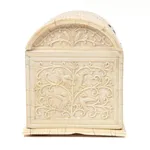
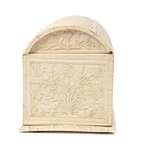
This rare dome-shaped casket, finely carved in ivory in low relief,was made in South China, probably in Zhangzhou, for export tothe Iberian markets, between the late sixteenth and early seventeenthcenturies.It belongs to a small group of similarly shaped caskets andrelated diminutive pieces of furniture carved in ivory, in a distinctivestyle of very low relief found nowhere else in Asia. This Zhangzhoucentredproduction also included figurative carvings in the round,mostly religious and Christian in iconography, which became animportant export commodity in the early modern period.1 Modelled after an earlier, late medieval European prototype,the casket features a rectangular box made from thick ivoryplaques joined together using woodworking techniques (with ivorypegs when needed), and its characteristic dome-shaped lid, likelytaking advantage of the natural curvature of the elephant’s tusk.The metal fittings include a lock plate in the shape of a double-headed eagle, and three hinges on the back; it was originallyfitted with a top handle, now missing, which would have hinderedthe legibility of the lid’s figural decoration.Adapted from contemporary European ornamental prints,the decoration of the casket includes ferronneries and rinceaux (vegetalscrolls) with animals (dogs and squirrels), and perched birdson the front; vegetal scrolls on the back; and flowering plants withanimals on the sides. These animal motifs include a curious isolated‘Pelican in her piety’ or pie pellicane—a mother pelican woundingherself to feed her young with her blood—a Christian motif widelyused in Portuguese-influenced Asia, mostly in textiles and furniture.Both spectacular and intriguing, the decoration on the dome-shapedlid derives from Mannerist prints in a style known as ‘strapwork’(Rollwerk in German), incorporating cartouches, ferronneries, andgrotesques (grotteschi in Italian), which, mainly from Antwerp,disseminated a new ornamental repertoire all over Europe andbeyond, including Asia. The lid features a grotesque panel with a‘strapwork’ cartouche in the centre, flanked by chimerical male andfemale figures blowing trumpets, crowned by a curious elderly figure.As usual in such Northern Mannerist prints, the backgroundof the grotesque is filled with drapes, garlands, masks, and animals,including a scorpion and a fish hanging from ribbons. Thecentral scene depicts the story of Jonah, known principally fromthe Hebrew Bible (the Book of Jonah).2 According to the biblicalstory, Jonah tries to flee God’s command to preach in Nineveh, isswallowed by a great fish, repents, and is delivered to complete hismission. In late sixteenth-century Counter-Reformation Europe,Jonah was commonly read as a figure of penitence, chastisement,and providential deliverance (and, typologically, of Christ’s deathand Resurrection), while also lending itself—by implicit analogy—to the perils and imperatives of Catholic missionary work in Asia.It is possible that, alongside an ornamental print, suchas those published by Hieronymus Cock (ca. 1518–1570) after designsby Cornelis Floris (ca. 1514–1575), the Chinese carver used a 1566 print by Philips Galle, after a composition by Maarten vanHeemskerk, depicting the story of Jonah.3 In the print, Jonah isregurgitated by a monstrous fish onto dry land, overseen by Godthe Father above, in the clouds. Although mirrored—a widely usedprocess in copying prints—the carved Jonah is similar in pose andgestures to that of the print, and the same is true of the monstrousfish, its curling tail, and the gush of liquid coming out of its mouth.Squeezed into the central field of the cartouche, however, Jonahinstead leans over the fish, rather than being expelled from hisbelly—this may well derive not only from spatial constraints, butfrom Chinese myth, given that the Daoist immortal Qin Gao disappearsinto the water and later reappears riding a red carp, beforedeparting again, a story which influenced many Chinese artworks,in painted and sculptural form.4 The elderly, haloed figure crowningthe cartouche carved on the lid may thus be identified with Godthe Father, similarly adapted by the Chinese craftsman, combinedwith the more familiar iconography of another Daoist immortal,possibly Laozi. As with other productions for export to the Europeanmarket—and apart from the strong Daoist iconographical overlapping—the figurative and ornamental motifs are Sinicised, witha typical Chinese stylisation of forms and the inclusion of motifsspecific to art made in China, most notably the curling of vegetalscrolls reminiscent of the rúyì, which derives from the head of thelíngzhī, or mushroom of immortality (Ganoderma sichuanense), andsymbolises power, good fortune, and granting of wishes.Zhangzhou, one of the most important coastal cities ofFujian Province, was a notable centre for ivory carving in late Ming China. The tradition of carving secular and religious figures(for Buddhist and Daoist private shrines) in ivory in southernFujian was bolstered by the emergence of a new appreciation andconsumption of luxury goods among the urban elite. This shift,far removed from the more austere tastes of the literati, coincidedwith the appearance of a new European clientele.5 Europeanswith access to the Fujian markets and their local and hinterlandagents—merchants and Christian missionaries alike—likely begancommissioning not only religious ivory carvings, but also decorativeitems, including small pieces of furniture such as the presentcasket. No more than a handful of similarly shaped caskets fromthis production are known, mostly in Portuguese private collections.One very small casket, with a dome-shaped lid (12.8 × 8.2 × 9.6cm), now in a Lisbon private collection, was published in 2000 bythe antiques dealer Manuel Castilho—the first to recognize thisproduction and to draw attention to its importance.6 Carved in thesame shallow relief and copying similar European engravings, thecasket features ferronneries on the front and back; Mannerist-stylegrotesques (with putti, masks, and vases) on the lid; and huntingscenes on the sides, highly favoured by the aristocratic and patricianPortuguese, and perhaps Spanish, clientele who commissioned suchobjects from South China, likely through middlemen stationed inPortuguese-settled Macau. It is set with silver fittings, including acast top handle (with dragon heads), which may have been similarto the missing handle on this casket.
HMC
1 This group of Chinese household objects is virtually unknown and largely unpublished. For the religious ivory carvings related to this production, see Crespo, Hugo Miguel, Chinese ChristianArt. From the South China Sea to the Imperial Court (1580–1900), Lisbon, São Roque Antiguidades & Galeria de Arte, 2025.
2 On the significance of the story of Jonah, see Sherwood, Yvonne, A Biblical Text and Its Afterlives. The Survival of Jonah in Western Culture, Cambridge, Cambridge University Press, 2000;and particularly in the early modern period, in art and literature, see also Burroughs, Charles, ‘The ‘Last Judgment’ of Michelangelo: Pictorial Space, Sacred Topography, and the SocialWorld’, Artibus et Historiae 16.32 (1995), pp. 55–89; and Hamlin, Hannibal, ‘Staging Prophecy: A Looking Glass for London and the Book of Jonah’, in Goodblatt, Chanita, von Contzen,Eva (eds.), Enacting the Bible in Medieval and Early Modern Drama, Manchester, Manchester University Press, 2020, pp. 175–191.
3 The British Museum, London (inv. 1937,0915.263).
4 One highly significant example is a fifteenth-century painting by Li Zai in the Shanghai Museum.
5 See Gillman, Derek, ‘Ming and Qing Ivories: figure carving’, in Watson, William (ed.), Chinese Ivories from the Shang to the Qing, London, The Oriental Ceramic Society–British Museum,1984, pp. 35–52.
6 Castilho, Manuel, Missions in the East. The Route to Lisbon and the Route to Acapulco, Lisbon, Manuel Castilho Antiguidades, 2000, pp. 60–61, cat. 22.
HMC
1 This group of Chinese household objects is virtually unknown and largely unpublished. For the religious ivory carvings related to this production, see Crespo, Hugo Miguel, Chinese ChristianArt. From the South China Sea to the Imperial Court (1580–1900), Lisbon, São Roque Antiguidades & Galeria de Arte, 2025.
2 On the significance of the story of Jonah, see Sherwood, Yvonne, A Biblical Text and Its Afterlives. The Survival of Jonah in Western Culture, Cambridge, Cambridge University Press, 2000;and particularly in the early modern period, in art and literature, see also Burroughs, Charles, ‘The ‘Last Judgment’ of Michelangelo: Pictorial Space, Sacred Topography, and the SocialWorld’, Artibus et Historiae 16.32 (1995), pp. 55–89; and Hamlin, Hannibal, ‘Staging Prophecy: A Looking Glass for London and the Book of Jonah’, in Goodblatt, Chanita, von Contzen,Eva (eds.), Enacting the Bible in Medieval and Early Modern Drama, Manchester, Manchester University Press, 2020, pp. 175–191.
3 The British Museum, London (inv. 1937,0915.263).
4 One highly significant example is a fifteenth-century painting by Li Zai in the Shanghai Museum.
5 See Gillman, Derek, ‘Ming and Qing Ivories: figure carving’, in Watson, William (ed.), Chinese Ivories from the Shang to the Qing, London, The Oriental Ceramic Society–British Museum,1984, pp. 35–52.
6 Castilho, Manuel, Missions in the East. The Route to Lisbon and the Route to Acapulco, Lisbon, Manuel Castilho Antiguidades, 2000, pp. 60–61, cat. 22.
Join our mailing list
* denotes required fields
We will process the personal data you have supplied to communicate with you in accordance with our Privacy Policy. You can unsubscribe or change your preferences at any time by clicking the link in our emails.