


An Indo-Portuguese writing cabinet with two noblemen sitting, India, Gujarat; late 16th century
Teak, Indian rosewood ivory, brass and iron; iron fittings
28.5 × 44.0 × 31.0 cm
F1394
Further images
-
(View a larger image of thumbnail 1
)
-
(View a larger image of thumbnail 2
)

-
(View a larger image of thumbnail 3
)

-
(View a larger image of thumbnail 4
)

-
(View a larger image of thumbnail 5
)
-
(View a larger image of thumbnail 6
)

-
(View a larger image of thumbnail 7
)

-
(View a larger image of thumbnail 8
)

-
(View a larger image of thumbnail 9
)

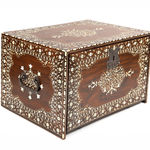
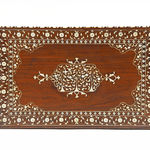
This fall-front writing cabinet, produced in late 16th century Gujarat for the Portuguese market, replicates a well-known European prototype . The teak carcass (Tectona grandis), veneered in Indian rosewood (Dalbergia latifolia) and inlaid in elephant tusk ivory, features wrought iron fittings that include two robust side handles and fall front and central drawer double headed eagle lock escutcheons. This motif portraying the gandabherunda, mythological Hindu bird imbued of magical strength, wards off evil and protects the cabinet’s precious contents. The drawers do also feature delicate turned ivory pulls .The outer decorative composition, as well as the fall front inner surface, are characterized by rug like patterns of lobate central cartouches and inner band, filled by foliage elements, and by a broad border with foliage scrolls of eight petalled rosettes and comma shaped leaves, typical of this Gujarati production derived from the International Timurid grammar.When exposed, the cabinet inner front exhibits an arrangement of six drawers, simulating eight, arranged over three tiers centred by one double height drawer with individual lock. The drawer fronts inlaid decoration consists of flowering plants flanked by face-to-face placed goats; On the larger drawer the composition rests on a European type of balustrade, thus copying the architectural elements of European made cabinets.From the inner fall front ornamental composition, densely filled by flowering trees, stand out two seated Portuguese male figures, seemingly in conversation, attired in long sleeved jerkins, loose trousers, ruff collars and tall hats.Besides tabletop and dais cabinets, the present example replicates a European prototype that ranked highly amongst the most prestigious 16th century storage furniture typologies. The fall front formed a surface suitable for writing, while the multiple drawers provided easy access to the precious objects and writing paraphernalia therein stored. Such luxury cabinets predominated in the elites’ homes and portable examples, such as the one described, would become indispensable for European officials and merchants settled in or travelling through Asia .Such Eastern objects, produced with exotic and costly raw materials, were much desirable and sought after by Europeans for their practical design, technical mastery and decorative fineness.
This fall-front writing cabinet, produced in late 16th century Gujarat for the Portuguese market, replicates a well-known European prototype . The teak carcass (Tectona grandis), veneered in Indian rosewood (Dalbergia latifolia) and inlaid in elephant tusk ivory, features wrought iron fittings that include two robust side handles and fall front and central drawer double headed eagle lock escutcheons. This motif portraying the gandabherunda, mythological Hindu bird imbued of magical strength, wards off evil and protects the cabinet’s precious contents. The drawers do also feature delicate turned ivory pulls .The outer decorative composition, as well as the fall front inner surface, are characterized by rug like patterns of lobate central cartouches and inner band, filled by foliage elements, and by a broad border with foliage scrolls of eight petalled rosettes and comma shaped leaves, typical of this Gujarati production derived from the International Timurid grammar.When exposed, the cabinet inner front exhibits an arrangement of six drawers, simulating eight, arranged over three tiers centred by one double height drawer with individual lock. The drawer fronts inlaid decoration consists of flowering plants flanked by face-to-face placed goats; On the larger drawer the composition rests on a European type of balustrade, thus copying the architectural elements of European made cabinets.From the inner fall front ornamental composition, densely filled by flowering trees, stand out two seated Portuguese male figures, seemingly in conversation, attired in long sleeved jerkins, loose trousers, ruff collars and tall hats.Besides tabletop and dais cabinets, the present example replicates a European prototype that ranked highly amongst the most prestigious 16th century storage furniture typologies. The fall front formed a surface suitable for writing, while the multiple drawers provided easy access to the precious objects and writing paraphernalia therein stored. Such luxury cabinets predominated in the elites’ homes and portable examples, such as the one described, would become indispensable for European officials and merchants settled in or travelling through Asia .Such Eastern objects, produced with exotic and costly raw materials, were much desirable and sought after by Europeans for their practical design, technical mastery and decorative fineness.
Join our mailing list
* denotes required fields
We will process the personal data you have supplied to communicate with you in accordance with our Privacy Policy. You can unsubscribe or change your preferences at any time by clicking the link in our emails.