


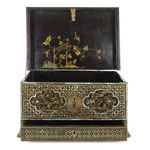
A Nipo-Portuguese Namban writing box, Japan; Momoyama period (1573–1615)
Cryptomeria japonica (?), lacquer, mother-of-pearl and gold; brass fittings
25.5 × 50.0 × 34.5 cm
F1333
Further images
-
(View a larger image of thumbnail 1
)

-
(View a larger image of thumbnail 2
)

-
(View a larger image of thumbnail 3
)

-
(View a larger image of thumbnail 4
)

-
(View a larger image of thumbnail 5
)

-
(View a larger image of thumbnail 6
)

-
(View a larger image of thumbnail 7
)
-
(View a larger image of thumbnail 8
)

Exceptional, rectangular shaped Namban writing casket of hinged cover. Wood made, possibly in Cryptomeria japonica, it was produced in the late-16th or in the early-17th century. The lifting cover gives access to a single compartment for storing writing paraphernalia, beneath which there is a long, single drawer, for documents. Copying a typically Iberian furniture model, the chest is decorated in black lacquer (urushi), gold (maqui-e), and mother-of-pearl (raden) inlays, characteristic of contemporary Japanese productions. The various brass hardware elements - handles, corner pieces, oval lock escutcheons and traditional European style latch, are engraved with foliage decorative compositions, and mercury gilt.From the chest’s outer surfaces stands out the cover, defined by a large cartouche of vegetable decorative composition centred by a pair of turtles (kame) - reptiles of exceptional longevity, that grew a long white tail whose exhaled vapours could create sacred jewels1 – with shells featuring a hexagons pattern known as Kikko-mon, originally from the Nara period (710-794), filled with birds and flowers (Karahana).Emerging from the water, the testudines are flanked by a lush Japanese maple tree (Acer palmatum) or Momizi, with a perched cuckoo (Hototogisu), and an orange tree (Tachibana). The surrounding surface is completed by intricate circles of mother-or-pearl intersections forming a star, centred by a flower. This compelling geometric pattern is repeated on the front panel. All the chest’s elevations, as well as the lid, are framed by a broad peripheral band of circles and demi-circles of stylized floral motifs, on a black lacquered ground, that alternate with mother-of-pearl elements centred by small black squares. The mother-of-pearl elements seem to correspond to the aogai, which radiates a turquoise blue sheen, and to the chogai shell, of whitish and iridescent lustre.1 Op. cit, BAIRD, Merrily, Symbols of Japan: thematic motifs art and design, Rizzoli International Publications, Inc., New York, 2001, p. 168.On the casket front, the rectangular surface is divided in two overlapping sections, corresponding to the upper single case compartment and to the lower drawer, delimited by decorative borders. The larger upper section is characterized by two scalloped, mother-of-pearl framed cartouches, flanking the exuberant lock plate. The one to the right features a pair of quail (uzura) among royal blue gentian flowers (rindo), both associated to Autumn. The other, to the left, an orange tree (tachibana), and what seems a Japanese nightingale (uguisu), bird associated with Japanese prose and poetry and whose song is related to the New Year, as evidenced in the Hatsune chapter of the literature classic Genji Monogatari (The Tale of Genji)2.Beneath this section, a full width drawer of geometric pattern decoration, centred by a small, and rather discreet lock escutcheon. On both lateral elevations, dense compositions with orange tree and royal blue gentian flower shrubs, to the right, and, to the left, a Paulownia tree (Kiri), in an allusion to the Japanese Imperial House and to Spring. On the back, a long outstretching Paulownia branch.The chest interior is fully lacquered in black. In the inner cover, a golden pergola sustaining a camellia shrub (Tsubaki), symbol of winter in the traditional Japanese floral calendar. Completing the scene, a grasshopper (Korogi) – a popular pet in Japan that is often pictured in lacquerware pieces – a crane (Tsuru), an allegory to longevity associated to the New Year, and, once again, a cuckoo.In terms of its decorative iconography, it is certain that the emphasis given to the turtles on the chest’s cover panel, relates to the fact that, according to Hindu, Taoist, Confucianist and Buddhist traditions, these testudines participate in the world’s evolution. For their longevity they are associated to the Taoist paradise, Mount Horai, and to the Aquatic palace of the Dragon-God, the King of the Seas. Turtles are frequent characters in Japanese folk tales, such as in the Urashima Taro, in which this reptile is the messenger of the Gods, able to travel between the underwater and the terrestrial worlds. On the other hand, in Japanese art they are associated to the Seven Gods of Good Fortune, a detail that is alluded to by the geometric ornamentation in which the pair is inserted, known and the “seven jewels pattern”, associated to these gods.An exceptional example of Namban art, this small piece of furniture alludes to life and death, as well as to life’s regeneration, metaphorically defined by the four seasons’ regular and continuous rotation. In addition to the evident beauty of this chest, we must also refer its2 Idem, p. 112.decorative sophistication that conveys an important artistic and cultural meaning, reinforced by the rare “seven jewels pattern” which, in a Japanese context becomes an allegory to the seven Shinto Gods of Good Fortune (shichi fukujin)3.Bernardo Morais dos Santos3 Cf. BAIRD, Merrily, Symbols of Japan: thematic
Join our mailing list
* denotes required fields
We will process the personal data you have supplied to communicate with you in accordance with our Privacy Policy. You can unsubscribe or change your preferences at any time by clicking the link in our emails.