


An Indo-Portuguese Gujarati casket, India, Gujarat, 16th c. (2nd half)
Tortoiseshell; silver mounts
13.5 × 19.5 × 13.5 cm
F1376
Further images
-
(View a larger image of thumbnail 1
)
-
(View a larger image of thumbnail 2
)
-
(View a larger image of thumbnail 3
)
-
(View a larger image of thumbnail 4
)
-
(View a larger image of thumbnail 5
)
-
(View a larger image of thumbnail 6
)
-
(View a larger image of thumbnail 7
)
-
(View a larger image of thumbnail 8
)
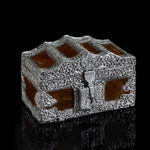
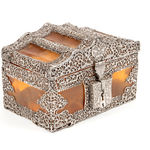
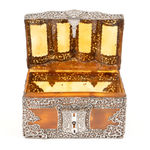
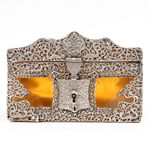
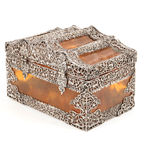
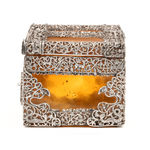
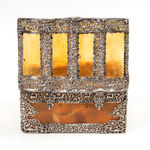
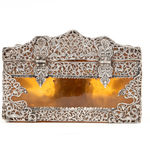
This rare, precious casket, from the second half of the sixteenth century, used originally as a jewel-box, is made out of golden, translucent tortoiseshell plaques devoid of the usual darker splotches which are characteristic of this exotic material. This means that the whole casket was made from the scutes of the ventral side of the tortoise. The physical process to which the material - the scutes from the carapace of the hawksbill sea turtle - was subjected in order to produce pieces of this size and thickness is termed autografting and ensures that no visible junctions are visible. Contrary to what has previously been assumed, it is possible to identify with certainty the animal species that served as the source for the material for this and all the other tortoiseshell caskets produced in Gujarat, in Cambay or Surat using this method. In fact, of the two marine tortoise species used in the production of decorative objects since time immemorial in Asia, the green sea turtle (Chelonia mydas) and the hawksbill sea turtle (Eretmochelys imbricata), only the latter is susceptible to this autograft process. One of the oldest documentary references to specific Gujarati tortoiseshell caskets, albeit no longer extant, is to be found on the post-mortem inventory of Afonso de Castelo Branco, bailiff of the Lisbon royal court dated to 1556: “one tortoiseshell casket mounted in silver worth 2,000 reais”. The unusual proportions of this casket tell us that it was profoundly altered or restored. It must have suffered a serious accident, most likely during its transport aboard the India Run, and was probably restored upon arrival in Lisbon. The front and back correspond to the sides of the original casket, thus shortened to around a third of its original length. This transformation entailed a new arrangement of the silver mounts, namely the removal of the original side handles (of which traces of the matching holes may be observed) and the repositioning of the lock. It is modelled after a fourteenth-century European prototype of a casket made to store precious books of hours, with the fluted lid being a rare feature of some of these caskets. A rare example of this type belongs to the Musée de Cluny-Musée national du Moyen Âge, Paris (inv. NNI 952).The silver mounts are also unusual, although their decoration of lizards (or dragons), lions, deer and birds on a background of vegetal scrolls and the outline of the Timurid-inspired brackets is common to a well-known group of these tortoiseshell caskets. One of the best known is the casket (12.0 x 27.3 x 21.0 cm), with a similar fluted lid and relief mounts, from the Igreja Matriz do Montijo. Interestingly, on the hinges that crown the locks of the present example and in the casket in Montijo, we see an Indian rhinoceros (Rhinoceros unicornis), while the heraldic shield-shaped locks are also identical, differing only in the latch; the original one in the casket in Montijo with its customary lizard, and the one in the present casket (chased with European vegetal motifs) probably dating from when it was transformed. To the same group belong the large caskets (30.5 cm long) in the Monasterio de San Lorenzo del Escorial, Madrid (invs. 10044680; and 10044687), gifted by Empress Maria of Austria (1528-1603) to Felipe II of Spain (r. 1556-1598) in 1589. The present casket stands out from all those known from this rare group as the silver bands in relief, probably made using metallic dies (bronze or iron) have a pierced openwork background, making the mounts lighter and highlighting the contrast with the tortoiseshell. It is likely that this difference also resides in the coeval alterations that the present casket underwent.
Hugo Miguel CrespoCentre for History, University of Lisbon
Bibliography:
Lison de Caunes, Jacques Morabito, L'écaille. Tortoiseshell, Paris, Éditions Vial, 1997
Hugo Miguel Crespo, Jewels from the India Run (cat.), Lisboa, Fundação Oriente, 2015
José Jordão Felgueiras, “Uma Família de Objectos Preciosos do Guzarate. A Family of Precious Gujurati Works”, in Nuno Vassallo e Silva (ed.), A Herança de Rauluchantim. The Heritage of Rauluchantim (cat.), Lisboa, Museu de S. Roque - Comissão Nacional para as Comemorações dos Descobrimentos Portugueses, 1996, pp. 151-153
J. Frazier, “Exploitation of Marine Turtles in the Indian Ocean”, Human Ecology, 8.4, 1980, pp. 329-370
Ana García Sanz, “Relicarios de Oriente”, in Marina Alfonso Mola, Carlos Martínez Shaw (eds.), Oriente en Palacio. Tesoros Asiáticos en las Colecciones Reales Españolas (cat.), Madrid, Palacio Real de Madrid - Patrimonio Nacional, 2003, pp. 128-141
Séverine Lepape, Michael Huynh, Caroline Vrand (eds.), Mistérieux coffrets. Estampes au temps de La Dame à la licorne (cat.), Paris, Bibliothèque nationale de France, Musée de Cluny-Musée national du Moyen Âge, Lienart, 2019
Hugo Miguel CrespoCentre for History, University of Lisbon
Bibliography:
Lison de Caunes, Jacques Morabito, L'écaille. Tortoiseshell, Paris, Éditions Vial, 1997
Hugo Miguel Crespo, Jewels from the India Run (cat.), Lisboa, Fundação Oriente, 2015
José Jordão Felgueiras, “Uma Família de Objectos Preciosos do Guzarate. A Family of Precious Gujurati Works”, in Nuno Vassallo e Silva (ed.), A Herança de Rauluchantim. The Heritage of Rauluchantim (cat.), Lisboa, Museu de S. Roque - Comissão Nacional para as Comemorações dos Descobrimentos Portugueses, 1996, pp. 151-153
J. Frazier, “Exploitation of Marine Turtles in the Indian Ocean”, Human Ecology, 8.4, 1980, pp. 329-370
Ana García Sanz, “Relicarios de Oriente”, in Marina Alfonso Mola, Carlos Martínez Shaw (eds.), Oriente en Palacio. Tesoros Asiáticos en las Colecciones Reales Españolas (cat.), Madrid, Palacio Real de Madrid - Patrimonio Nacional, 2003, pp. 128-141
Séverine Lepape, Michael Huynh, Caroline Vrand (eds.), Mistérieux coffrets. Estampes au temps de La Dame à la licorne (cat.), Paris, Bibliothèque nationale de France, Musée de Cluny-Musée national du Moyen Âge, Lienart, 2019
Provenance
Pedro Costa collection, Portugal.
This rare, precious casket, from the second half of the sixteenth century, used originally as a jewel-box, is made out of golden, translucent tortoiseshell plaques devoid of the usual darker splotches which are characteristic of this exotic material. This means that the whole casket was made from the scutes of the ventral side of the tortoise. The physical process to which the material - the scutes from the carapace of the hawksbill sea turtle - was subjected in order to produce pieces of this size and thickness is termed autografting and ensures that no visible junctions are visible. Contrary to what has previously been assumed, it is possible to identify with certainty the animal species that served as the source for the material for this and all the other tortoiseshell caskets produced in Gujarat, in Cambay or Surat using this method. In fact, of the two marine tortoise species used in the production of decorative objects since time immemorial in Asia, the green sea turtle (Chelonia mydas) and the hawksbill sea turtle (Eretmochelys imbricata), only the latter is susceptible to this autograft process. One of the oldest documentary references to specific Gujarati tortoiseshell caskets, albeit no longer extant, is to be found on the post-mortem inventory of Afonso de Castelo Branco, bailiff of the Lisbon royal court dated to 1556: “one tortoiseshell casket mounted in silver worth 2,000 reais”. The unusual proportions of this casket tell us that it was profoundly altered or restored. It must have suffered a serious accident, most likely during its transport aboard the India Run, and was probably restored upon arrival in Lisbon. The front and back correspond to the sides of the original casket, thus shortened to around a third of its original length. This transformation entailed a new arrangement of the silver mounts, namely the removal of the original side handles (of which traces of the matching holes may be observed) and the repositioning of the lock. It is modelled after a fourteenth-century European prototype of a casket made to store precious books of hours, with the fluted lid being a rare feature of some of these caskets. A rare example of this type belongs to the Musée de Cluny-Musée national du Moyen Âge, Paris (inv. NNI 952).The silver mounts are also unusual, although their decoration of lizards (or dragons), lions, deer and birds on a background of vegetal scrolls and the outline of the Timurid-inspired brackets is common to a well-known group of these tortoiseshell caskets. One of the best known is the casket (12.0 x 27.3 x 21.0 cm), with a similar fluted lid and relief mounts, from the Igreja Matriz do Montijo. Interestingly, on the hinges that crown the locks of the present example and in the casket in Montijo, we see an Indian rhinoceros (Rhinoceros unicornis), while the heraldic shield-shaped locks are also identical, differing only in the latch; the original one in the casket in Montijo with its customary lizard, and the one in the present casket (chased with European vegetal motifs) probably dating from when it was transformed. To the same group belong the large caskets (30.5 cm long) in the Monasterio de San Lorenzo del Escorial, Madrid (invs. 10044680; and 10044687), gifted by Empress Maria of Austria (1528-1603) to Felipe II of Spain (r. 1556-1598) in 1589. The present casket stands out from all those known from this rare group as the silver bands in relief, probably made using metallic dies (bronze or iron) have a pierced openwork background, making the mounts lighter and highlighting the contrast with the tortoiseshell. It is likely that this difference also resides in the coeval alterations that the present casket underwent.
Hugo Miguel CrespoCentre for History, University of Lisbon
Bibliography:
Lison de Caunes, Jacques Morabito, L'écaille. Tortoiseshell, Paris, Éditions Vial, 1997
Hugo Miguel Crespo, Jewels from the India Run (cat.), Lisboa, Fundação Oriente, 2015
José Jordão Felgueiras, “Uma Família de Objectos Preciosos do Guzarate. A Family of Precious Gujurati Works”, in Nuno Vassallo e Silva (ed.), A Herança de Rauluchantim. The Heritage of Rauluchantim (cat.), Lisboa, Museu de S. Roque - Comissão Nacional para as Comemorações dos Descobrimentos Portugueses, 1996, pp. 151-153
J. Frazier, “Exploitation of Marine Turtles in the Indian Ocean”, Human Ecology, 8.4, 1980, pp. 329-370
Ana García Sanz, “Relicarios de Oriente”, in Marina Alfonso Mola, Carlos Martínez Shaw (eds.), Oriente en Palacio. Tesoros Asiáticos en las Colecciones Reales Españolas (cat.), Madrid, Palacio Real de Madrid - Patrimonio Nacional, 2003, pp. 128-141
Séverine Lepape, Michael Huynh, Caroline Vrand (eds.), Mistérieux coffrets. Estampes au temps de La Dame à la licorne (cat.), Paris, Bibliothèque nationale de France, Musée de Cluny-Musée national du Moyen Âge, Lienart, 2019
Hugo Miguel CrespoCentre for History, University of Lisbon
Bibliography:
Lison de Caunes, Jacques Morabito, L'écaille. Tortoiseshell, Paris, Éditions Vial, 1997
Hugo Miguel Crespo, Jewels from the India Run (cat.), Lisboa, Fundação Oriente, 2015
José Jordão Felgueiras, “Uma Família de Objectos Preciosos do Guzarate. A Family of Precious Gujurati Works”, in Nuno Vassallo e Silva (ed.), A Herança de Rauluchantim. The Heritage of Rauluchantim (cat.), Lisboa, Museu de S. Roque - Comissão Nacional para as Comemorações dos Descobrimentos Portugueses, 1996, pp. 151-153
J. Frazier, “Exploitation of Marine Turtles in the Indian Ocean”, Human Ecology, 8.4, 1980, pp. 329-370
Ana García Sanz, “Relicarios de Oriente”, in Marina Alfonso Mola, Carlos Martínez Shaw (eds.), Oriente en Palacio. Tesoros Asiáticos en las Colecciones Reales Españolas (cat.), Madrid, Palacio Real de Madrid - Patrimonio Nacional, 2003, pp. 128-141
Séverine Lepape, Michael Huynh, Caroline Vrand (eds.), Mistérieux coffrets. Estampes au temps de La Dame à la licorne (cat.), Paris, Bibliothèque nationale de France, Musée de Cluny-Musée national du Moyen Âge, Lienart, 2019
Join our mailing list
* denotes required fields
We will process the personal data you have supplied to communicate with you in accordance with our Privacy Policy. You can unsubscribe or change your preferences at any time by clicking the link in our emails.