


An Indo-Portuguese Thane cabinet (ventó), India, Northern Province of the Portuguese State of India, probably Thane; 1600–1625
teak, ebony, ivory, bone, rosewood, sandalwood, brass and iron; gilt copper fittings
36.5 × 33.0 × 45.5 cm
F1441
Further images
-
(View a larger image of thumbnail 1
)
-
(View a larger image of thumbnail 2
)
-
(View a larger image of thumbnail 3
)
-
(View a larger image of thumbnail 4
)
-
(View a larger image of thumbnail 5
)
-
(View a larger image of thumbnail 6
)
-
(View a larger image of thumbnail 7
)
-
(View a larger image of thumbnail 8
)
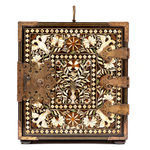
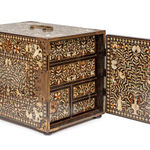
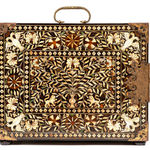
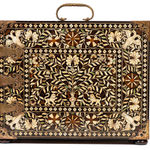
A cabinet made from teak (Tectona grandis), veneered with Ceylon ebony (Diospyros ebenum), and embellished with inlays of ivory, green-dyed animal bone, North Indian rosewood (Dalbergia sissoo) and sandalwood (Santalum album).
This cabinet replicates, in its form, an East Asian prototype known in Portuguese as a ventó. The Japanese term bentō, which passed into Portuguese according to the first Japanese-Portuguese dictionary—the Nippo jisho published as Vocabulario da lingoa de Iapam in 1603—was, and still is, a word for a lunch box. The original Japanese model for the ventó is known as kakesuzuri-bako, or ‘portable writing box’. When fitted with a front door and strongbox-like fittings, it is called funa-dansu, or ‘ship chest’ with drawers. This type of chest was designed to store seals, documents, writing instruments, and ink stones, alongside money. It features a single front door with hinges, often adorned with intricate metal fittings, and an interior comprising various drawers or compartments concealed behind the door.
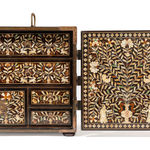
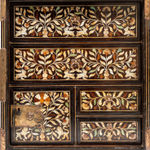
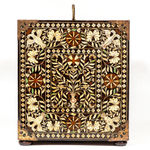
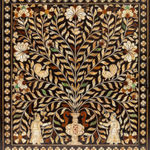
All exterior sides of this ventó display the same carpet-like decoration: a central field featuring a single flowering plant rising from a baluster-shaped vase, at times flanked by hares and peacocks, framed by a wide border of vegetal scrolls with star-shaped rosettes at the midpoints and crowned double-headed eagles (gaṇḍabheruṇḍa) at the corners. These elements are separated by friezes of quatrefoils, characteristic of this type of production. When opened, the cabinet reveals the typical East Asian arrangement of drawers: two larger drawers at the top for storing paper, two smaller ones below on the right, and a larger square-shaped drawer bellow on the left, making a total of five drawers arranged in four tiers. The drawer fronts are similarly decorated with flowering plants flanked by hares or lions. The interior side of the front door features a central field with a large flowering plant rising from a vase, flanked by two male European figures. Interestingly, from the head down, these figures are depicted wearing female attire typical of women’s fashion from the turn of the seventeenth century. This large panel is framed by a narrow border of quatrefoils.
It is fitted with fire-gilt copper fittings, which include a large Chinese-style lock plate on the front door, three hinges also on the door, corner braces, a handle on the top, a lock plate on the square-shaped drawer inside, and drawer loop pulls. The fittings, particularly the lock plates and corner braces, are masterfully chased with birds and rampant lions among vegetation.
Both the materials, decoration, and intricate fittings of this cabinet point to its origin in the Northern Province of the Portuguese State of India, likely in Thane. A comparable writing box (34.3 x 30.8 x 41.5 cm) from the same production, featuring similar decoration and likely made in the same workshop in Thane, is held in deposit at the Museu Nacional de Soares dos Reis, Porto (inv. 41 Mob CMP/MNSR) from the collection of the Museu da Cidade (Câmara Municipal do Porto).
Hugo Miguel Crespo
This cabinet replicates, in its form, an East Asian prototype known in Portuguese as a ventó. The Japanese term bentō, which passed into Portuguese according to the first Japanese-Portuguese dictionary—the Nippo jisho published as Vocabulario da lingoa de Iapam in 1603—was, and still is, a word for a lunch box. The original Japanese model for the ventó is known as kakesuzuri-bako, or ‘portable writing box’. When fitted with a front door and strongbox-like fittings, it is called funa-dansu, or ‘ship chest’ with drawers. This type of chest was designed to store seals, documents, writing instruments, and ink stones, alongside money. It features a single front door with hinges, often adorned with intricate metal fittings, and an interior comprising various drawers or compartments concealed behind the door.
All exterior sides of this ventó display the same carpet-like decoration: a central field featuring a single flowering plant rising from a baluster-shaped vase, at times flanked by hares and peacocks, framed by a wide border of vegetal scrolls with star-shaped rosettes at the midpoints and crowned double-headed eagles (gaṇḍabheruṇḍa) at the corners. These elements are separated by friezes of quatrefoils, characteristic of this type of production. When opened, the cabinet reveals the typical East Asian arrangement of drawers: two larger drawers at the top for storing paper, two smaller ones below on the right, and a larger square-shaped drawer bellow on the left, making a total of five drawers arranged in four tiers. The drawer fronts are similarly decorated with flowering plants flanked by hares or lions. The interior side of the front door features a central field with a large flowering plant rising from a vase, flanked by two male European figures. Interestingly, from the head down, these figures are depicted wearing female attire typical of women’s fashion from the turn of the seventeenth century. This large panel is framed by a narrow border of quatrefoils.
It is fitted with fire-gilt copper fittings, which include a large Chinese-style lock plate on the front door, three hinges also on the door, corner braces, a handle on the top, a lock plate on the square-shaped drawer inside, and drawer loop pulls. The fittings, particularly the lock plates and corner braces, are masterfully chased with birds and rampant lions among vegetation.
Both the materials, decoration, and intricate fittings of this cabinet point to its origin in the Northern Province of the Portuguese State of India, likely in Thane. A comparable writing box (34.3 x 30.8 x 41.5 cm) from the same production, featuring similar decoration and likely made in the same workshop in Thane, is held in deposit at the Museu Nacional de Soares dos Reis, Porto (inv. 41 Mob CMP/MNSR) from the collection of the Museu da Cidade (Câmara Municipal do Porto).
Hugo Miguel Crespo
Join our mailing list
* denotes required fields
We will process the personal data you have supplied to communicate with you in accordance with our Privacy Policy. You can unsubscribe or change your preferences at any time by clicking the link in our emails.