


A D. João V Portuguese cutlery set and knife box, Portugal, Lisbon, 1745-1750
Further images
-
(View a larger image of thumbnail 1
)
-
(View a larger image of thumbnail 2
)
-
(View a larger image of thumbnail 3
)
-
(View a larger image of thumbnail 4
)
-
(View a larger image of thumbnail 5
)
-
(View a larger image of thumbnail 6
)
-
(View a larger image of thumbnail 7
)
-
(View a larger image of thumbnail 8
)
-
(View a larger image of thumbnail 9
)
-
(View a larger image of thumbnail 10
)

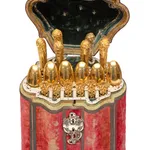
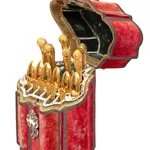
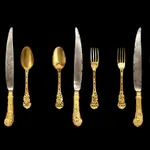
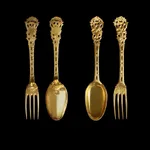
This spectacular table cutlery set (faqueiro in Portuguese), made of gold, survives with its original knife box (estojo de faqueiro). Produced in Lisbon in the second half of the 1740s, its remarkable survival—given the princely material from which it is made, totalling around 1,400 grams of gold—offers a powerful testament to the conspicuous consumption of gold objects, particularly for the dining table, at the Portuguese royal court.[1]
Knife boxes usually stood in pairs on sideboards, allowing servants could lay out fresh cutlery for each course. Given the choice of material, this set was intended for a more familiar, intimate dining context, serving only six diners.
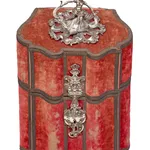
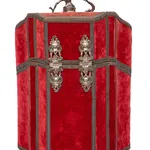
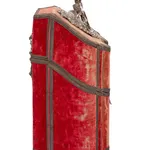
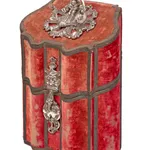
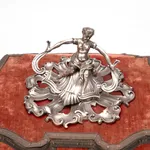
The rectangular knife box, with its characteristically Baroque serpentine-shaped front and flat sloping lid, is covered externally in crimson silk velvet—a colour usually reserved for royalty—and lined internally with forest-green silk velvet, both trimmed with silver braid. Fitted with exuberant cast and chased silver fittings (handle, lock plate and latch, and two hinges at the back), the box reveals eighteen compartments arranged across four tiers when opened.
It contains one set of six knives, six spoons, and six forks.[2] With the exception of the knives—with their steel blades and handles made from sheet gold worked in repoussé, chased and engraved, and filled with a resinous cutler’s cement—the solid-gold spoons and forks were forged from ingots, then finely chased and engraved with a burin. The openwork stems of both spoons and forks were chisel-cut, while the shield-shaped reserves at the ends of the handles (on the reverse), typically intended for monograms—or, more likely, the owner’s heraldry—remain blank.
According to family tradition, the set and box were gifted by King John V (r. 1706-1750) to one of his mistresses living near Estremoz. This claim is not implausible. Gold objects were strictly reserved for the monarch and the royal family, and the style—beautifully merging the earlier Portuguese Baroque repertoire, French Régence ornament, and the newly introduced rocaille motifs—points to the final years of John V’s reign.
This transitional idiom combines the characteristic masks (on the lower parts of the forks’ tines and spoons’ bowls, where they meet the handle, and most prominently on the box’s latch) familiar from Portuguese Baroque display silver around 1700, combined with the Régence trellis (quadrillage) pattern and the experimental rocaille ornament—previously unseen in Portuguese decorative arts—that would become prevalent under the king’s successor, Joseph I (r. 1750-1777).
As the pieces bear no marks, the identity of the accomplished silversmith responsible for this gold cutlery set is difficult to establish with certainty. Comparisons with the rare surviving gold objects from this pivotal phase of experimentation—spanning the closing years of John V’s reign, the king’s death in 1750, and the devastation of Lisbon in the 1755 earthquake—suggest the workshop of Manuel Roque Ferrão (fl. 1728-1785), one of Lisbon’s most prolific silversmiths. His long career and documented corpus of work encompass the principal decorative styles of the eighteenth century, from the late Baroque and the height of the Rococo to the early onset of Neoclassicism.
HMC
[1] The gold cutlery set and knife box are the subject of a monograph with contributions by several authors edited by Hugo Miguel Crespo (ed.), Magnanimous. A Gold Cutlery Set for the King of Portugal. Gold during the reign of John V, Lisbon, São Roque Antiguidades & Galeria de Arte, 2026.
[2] With regard to the gold alloys, observation under a stereomicroscope revealed, exclusively on the knives, the presence of grey-coloured metallic inclusions. X-ray fluorescence analysis identified these inclusions as consisting of osmium and iridium. The presence of this type of inclusion indicates the use of alluvial gold in the manufacture of the alloys.
HMC
2 With regard to the gold alloys, observation under a stereomicroscope revealed, exclusively on the knives, the presence of grey-coloured metallic inclusions. X-ray fluorescence analysisidentified these inclusions as consisting of osmium and iridium. The presence of this type of inclusion indicates the use of alluvial gold in the manufacture of the alloys.
Join our mailing list
* denotes required fields
We will process the personal data you have supplied to communicate with you in accordance with our Privacy Policy. You can unsubscribe or change your preferences at any time by clicking the link in our emails.