


An Indo-Portuguese Chaul painted ventó, India, probably Chaul, early 17th century
wood, dyed shellac and silver
28.5 × 26.5 × 36.5 cm
F1396
Further images
-
(View a larger image of thumbnail 1
)
-
(View a larger image of thumbnail 2
)
-
(View a larger image of thumbnail 3
)
-
(View a larger image of thumbnail 4
)
-
(View a larger image of thumbnail 5
)
-
(View a larger image of thumbnail 6
)
-
(View a larger image of thumbnail 7
)
-
(View a larger image of thumbnail 8
)
-
(View a larger image of thumbnail 9
)
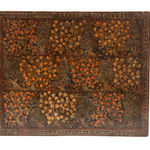
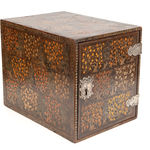
Such rare storage furniture typologies – boxes with one door to their narrower sides, opening towards the right and featuring inner drawers of various formats – became known in Portuguese as ventó, from the Japanese word bento. Nonetheless, and according to the earliest Nippo-Portuguese dictionary, the “Vocabulario da lingoa de Iapam”, published in 1603, the Japanese bentō, refers, even nowadays, to a food box.The original Japanese prototype for the ventó is known as kakesuzuri-bako, literally a “portable writing box”. However, when featuring a single door to one of its shorter sides, and robust safe like hardware, this box is named dansu, or “sea chest” - a “seal box” destined for storing writing paraphernalia or valuables such as coins .As such, and contrary to most other typologies, the ventó reflects a Japanese, rather than a European model, a detail that grants it a unique position in the context of Asian made furniture for the European market.
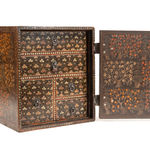
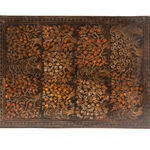
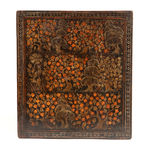
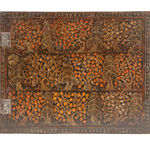
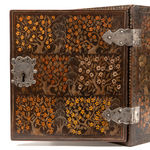
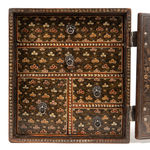
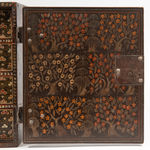
Of teakwood carcass (Tectona grandis), this ventó features unique bright coloured and vibrant shellac painted decoration, characterised by three horizontal rows of stylized flowering plants, bushes and trees, on all its outer elevations and inner door. This rug-like pattern composition comprises of large central grounds filled with floral rows, whose stylization does not allow for botanical identification, and narrow, purely geometrical borders.The box silver fittings include ring pulls, hinges and a shield shaped and pierced lock escutcheon that is reminiscent of European Mannerist heraldic. Also of far eastern influence, as expected in this type of object and production, the metalware finely chiselled ornamentation of foliage scrolls and ruyi shaped motifs, does however reveal Chinese, rather than Japanese, inspiration.Once open, the box exhibits a group of five different drawers arranged over four tiers, with a larger, double height square drawer to the lower left side, their brightly dyed shellac painted decoration following a reticulated textile pattern of stylized serrated leaves and white highlighted three petalled flowers.
This ventó belongs to a specific group of boxes featuring dyed shellac decoration. Despite the existence of furniture with identical ornamentation produced in India’s north-western coast for exporting to the Portuguese and other European markets, this cluster suggests an entirely different origin . Recent documental research points to Chaul, then a part of Portuguese India’s northern province, and modern day Revdanda Fort, in Maharashtra, as the origin for this uncommon production. In his travel journal, François Pyrard de Laval (ca. 1578-ca. 1623), refers that “[Chaul’s] main production are the silks fabrics, made in such quantities that almost supply the needs of Goa and all of India, being completely different from those made in China”. Besides these silk textiles, this author also reports that Chaul produces “a large quantity of caskets, chests, boxes and writing cabinets in the manner of China and very well made” and “lacquered cots and beds of every colour” .In addition to our recently identified example, only a handful of similarly decorated ventós are known. Two of these, from the Celso Roboredo Madeira Almendra collection, were for several decades exhibited at the National Museum of Ancient Art, in Lisbon. One other, (36.5 x 33.0 x 46.0 cm), of floral reliefs decoration similar to one of the above, belongs to the Távora-Sequeira Pinto collection, in Oporto . Both of black coloured ground surface, they feature more formal floral arrangements, possibly inspired by contemporary botanical prints. The inner door and drawer fronts of the Roboredo Madeira ventó feature scenes depicting Portuguese architectures, including a church, couples attired in contemporary Portuguese costume, and even African servants holding parasols, as well as peculiar hunting depictions such as a Franciscan friar shooting birds with an arquebus, hunters on horseback, and scenes with tigers and deer. All these aspects corroborate the suggestion of Portuguese ruled Chaul as its likely production centre.On its door interior, of bright orange-red ground, the second Roboredo Madeira box depicts a landscape with a Portuguese building, with characteristic high pitched tiled roof, and a large flowering tree like the one present on our box.All these examples, contrary to the varnished furniture produced in northern India, namely in Sindh and in the European taste, share a common far eastern, or even a Chinese influence, in their ornamental grammar. The present ventó textile patterning of floral reticulated motifs does most certainly suggest a more southern Indian artistic tradition.
Of teakwood carcass (Tectona grandis), this ventó features unique bright coloured and vibrant shellac painted decoration, characterised by three horizontal rows of stylized flowering plants, bushes and trees, on all its outer elevations and inner door. This rug-like pattern composition comprises of large central grounds filled with floral rows, whose stylization does not allow for botanical identification, and narrow, purely geometrical borders.The box silver fittings include ring pulls, hinges and a shield shaped and pierced lock escutcheon that is reminiscent of European Mannerist heraldic. Also of far eastern influence, as expected in this type of object and production, the metalware finely chiselled ornamentation of foliage scrolls and ruyi shaped motifs, does however reveal Chinese, rather than Japanese, inspiration.Once open, the box exhibits a group of five different drawers arranged over four tiers, with a larger, double height square drawer to the lower left side, their brightly dyed shellac painted decoration following a reticulated textile pattern of stylized serrated leaves and white highlighted three petalled flowers.
This ventó belongs to a specific group of boxes featuring dyed shellac decoration. Despite the existence of furniture with identical ornamentation produced in India’s north-western coast for exporting to the Portuguese and other European markets, this cluster suggests an entirely different origin . Recent documental research points to Chaul, then a part of Portuguese India’s northern province, and modern day Revdanda Fort, in Maharashtra, as the origin for this uncommon production. In his travel journal, François Pyrard de Laval (ca. 1578-ca. 1623), refers that “[Chaul’s] main production are the silks fabrics, made in such quantities that almost supply the needs of Goa and all of India, being completely different from those made in China”. Besides these silk textiles, this author also reports that Chaul produces “a large quantity of caskets, chests, boxes and writing cabinets in the manner of China and very well made” and “lacquered cots and beds of every colour” .In addition to our recently identified example, only a handful of similarly decorated ventós are known. Two of these, from the Celso Roboredo Madeira Almendra collection, were for several decades exhibited at the National Museum of Ancient Art, in Lisbon. One other, (36.5 x 33.0 x 46.0 cm), of floral reliefs decoration similar to one of the above, belongs to the Távora-Sequeira Pinto collection, in Oporto . Both of black coloured ground surface, they feature more formal floral arrangements, possibly inspired by contemporary botanical prints. The inner door and drawer fronts of the Roboredo Madeira ventó feature scenes depicting Portuguese architectures, including a church, couples attired in contemporary Portuguese costume, and even African servants holding parasols, as well as peculiar hunting depictions such as a Franciscan friar shooting birds with an arquebus, hunters on horseback, and scenes with tigers and deer. All these aspects corroborate the suggestion of Portuguese ruled Chaul as its likely production centre.On its door interior, of bright orange-red ground, the second Roboredo Madeira box depicts a landscape with a Portuguese building, with characteristic high pitched tiled roof, and a large flowering tree like the one present on our box.All these examples, contrary to the varnished furniture produced in northern India, namely in Sindh and in the European taste, share a common far eastern, or even a Chinese influence, in their ornamental grammar. The present ventó textile patterning of floral reticulated motifs does most certainly suggest a more southern Indian artistic tradition.
Join our mailing list
* denotes required fields
We will process the personal data you have supplied to communicate with you in accordance with our Privacy Policy. You can unsubscribe or change your preferences at any time by clicking the link in our emails.